What IBM's Quantum Computer Thinks About the Iran War
I gave my AI full access to IBM's superconducting quantum processors. Here's what it told me about the Iran war, global trade, and the United Nations.

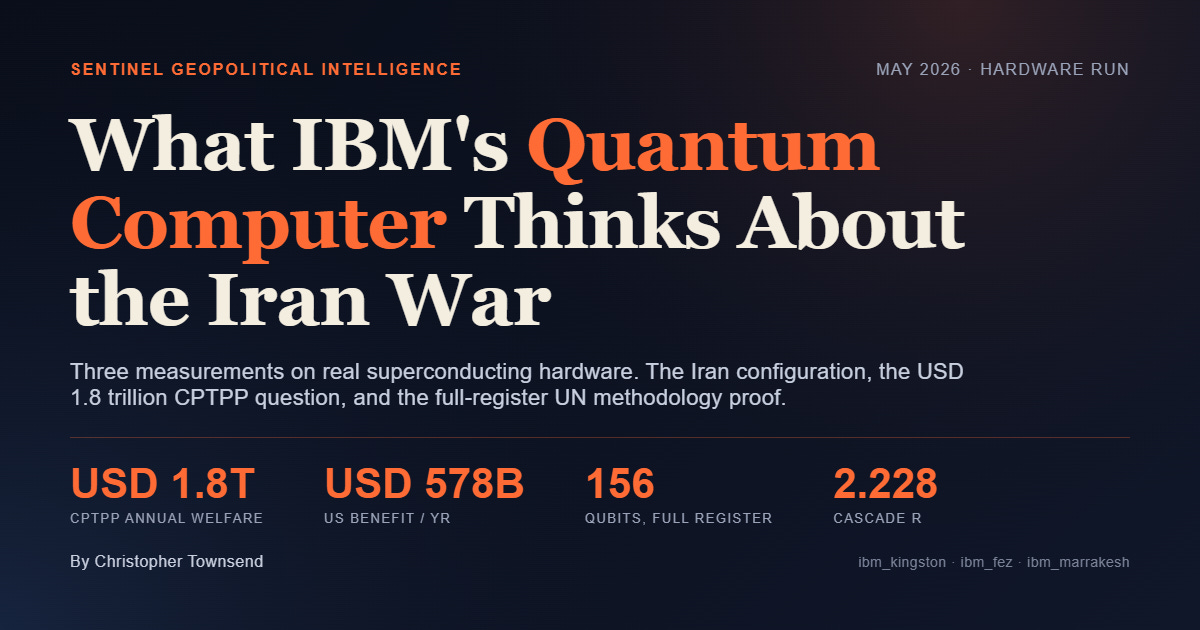
Not a simulation. Not a metaphor. A measurement.
The processor was unambiguous. Iran de-escalates at ninety-eight per cent of measurement shots. Israel and the United States escalate at ninety-five. Saudi Arabia and the UAE de-escalate at ninety-six and ninety-seven. Hezbollah escalates at seventy-three. The Houthis split. Russia and China — encoded together as a composite Eastern bloc — lean into Iranian oil purchases at sixty-three per cent.
At the same time I ran a different question on the same chip. Thirty-two of the world’s most plurilaterally active economies. The G20 plus twelve middle-power architects of the post-WTO trade order. Same instrument. Same processor in Poughkeepsie. Different couplings.
The result was a number nobody had calculated before. The Comprehensive and Progressive Agreement for the Trans-Pacific Partnership — the eleven-country trade pact the United States walked away from in January 2017 — is worth roughly one point eight trillion dollars a year in annual welfare to the global economy. The single largest beneficiary is the country that walked away.
Then I asked it about the United Nations. The result there is a different kind of result, and the section on it explains why.
This is what came out, and what it means.
How can a fridge in Poughkeepsie measure a war?
What the hardware does, given the right kind of question, is hold every possible configuration of a multi-player strategic system simultaneously, as a single physical object, and tell you by measurement which configuration the system has settled into. The trick is in the encoding.
Imagine a collection of magnets. Each magnet has a tilt — a preference for pointing one way rather than the other. Each pair of magnets has an opinion of each other, pulling toward alignment or pushing toward opposition. Hand the math the tilts and the pulls, and the math asks a single question: given everyone’s preferences and everyone’s relationships, what arrangement does the whole collection want to be in?
That arrangement is called the ground state. The lowest-energy configuration. The bottom of the deepest bowl in a landscape of bowls. In a strategic system, the ground state corresponds to a Nash equilibrium — a configuration nobody wants to leave, given what everyone else is doing. The math gives you the bowls. The quantum hardware finds the marble.
What the encoding actually does is force you to be specific about your players, your strategies, and your couplings in a way that prose game theory does not. A diplomatic essay can be ambiguous about Iran’s preferences. The math cannot. Either you write down a number for Iran’s preference field, or you do not have a Hamiltonian.
The Iran encoding had eight players, each with a binary choice — escalate or de-escalate. The trade encoding had thirty-two. A laptop can enumerate eight-player problems in microseconds and thirty-two-player problems in seconds. The hardware is not, at this scale, faster. What it does is verify that the encoding’s ground state matches the equilibrium independent classical engines identify. It also generalises to fifty- or hundred-player systems where the laptop runs out of room. The contribution at this scale is the existence proof. The scaling is for later.
I built the encodings with the help of an AI to which I gave direct access to the IBM quantum stack. The AI wrote much of the supporting code; I made the modelling decisions and read the engine output. The hardware did the measuring.
What did it say about the war?
Eight independent strategic decisions. Eight identifications by the run. The configuration is called Selective Pressure. Iran de-escalates. Israel escalates. The United States escalates. Saudi Arabia and the UAE de-escalate. Hezbollah escalates. The Houthis split. Russia and China lean into Iranian oil purchases above the Western price cap.
This is not a forecast. The processor is identifying what the regional system is doing, as of late April 2026, after the Pakistan-brokered ceasefire of April 8 holds in the main theatre but excludes Lebanon. Selective Pressure is the configuration the system has settled into.
Iran is not de-escalating because it has chosen peace. Iran is de-escalating because the math has worked out that escalation is no longer its best move given what everyone else is doing. The reason Iran sits in the de-escalating column is that the cost structure of the configuration has made escalation expensive — sanctions tightening, oil-cap enforcement, isolation from European banks, the loss of the JCPOA framework after the United States exited it in 2018. Iran would prefer a different configuration. The system will not give it one.
Israel and the United States escalate because in this configuration, escalation pays them. Saudi Arabia and the UAE de-escalate because they are pursuing the 2023 normalisation track with Iran and want United States security infrastructure on their soil without becoming the front line of a war they did not start. Hezbollah escalates because the Lebanese state is too weak to constrain it, and the costs of escalation accrue to the Lebanese population, not to Hezbollah’s leadership.
The cascade reproduction number for this system — the metric that asks, when one player escalates, how many further escalations does that move trigger on average — is two point two two eight. Above two means each escalation triggers more than two further escalations. The system is well above the self-sustaining threshold. The cascade does not die out on its own.
Hezbollah is the most pivotal of the eight players. Its Shapley value — the average contribution it makes to the system’s coalitional value across all the orderings in which the players could be added — is the highest of the eight. The implication is that severing or transforming Hezbollah’s role has the largest single-actor effect on the cascade dynamics. Hezbollah disarmament under Lebanese Armed Forces authority is the highest-leverage single-actor lever available. It is not a solution. It is a lever.
The most informative run was a counter-argument. I wanted to know whether the equilibrium was an artefact of Iran’s hostile preference field, or whether it was a property of the coupling structure across all eight players. So I submitted a variant Hamiltonian: same couplings, same other preferences, but Iran’s preference field forced to extreme dovishness. If the equilibrium were a function of Iranian belligerence, the variant should have produced a different ground state.
The variant produced the same regional configuration. Selective Pressure is not Iran-driven. It is a property of the system as a whole. Unilateral Iranian dovishness — the kind of behaviour Western analysts have been asking Tehran to display for two decades — does not pull the regional system toward peace, because the configuration is held in place by what everyone else is doing, not by what Iran is doing.
This refutes a quietly held assumption in Western policy circles: that Iranian behaviour is the keystone variable, and that getting Iran to step back would unwind the regional crisis. The result says it would not.
The picture from the run is more pessimistic than the prose narrative on three counts. The cascade is more reproductive than the consensus claims. Fragility is more saturated. The political core of the participating actors is more cohesive. None of these is reassuring. All of them are now measurable.
Where trade fails, bullets follow.
Trade architecture is the layer above the security layer. When trade rules retire, security rules wake up and start working overtime. The institutions are not interchangeable. The instruments are not equivalent. And the human consequence of the substitution is not abstract.
When the JCPOA fell in 2018, what filled the vacuum was sanctions architecture. Then naval enforcement. Then a price cap on Iranian crude. Then proxies in Yemen and Lebanon. Then, on 28 February 2026, Operation Epic Fury. Each step was the security layer doing what the trade layer no longer could.
This is not a deterministic claim. It is an institutional one. When trade rules break, security rules take over. Bullets follow.
What did it say about the trade system?
Roughly one point eight trillion United States dollars in annual welfare is created globally by the existence of CPTPP — the eleven-country trade pact that the United States walked away from in January 2017.
The number itself is striking. The distribution of the number across countries is more striking still.
The two largest losers from a counterfactual world without the agreement are the United States, at five hundred and seventy-eight billion dollars in annual welfare loss, and Japan, at five hundred and fifty-four billion. The United States is not a CPTPP member. It withdrew from the predecessor Trans-Pacific Partnership in the first month of the first Trump administration. The fact that it would lose more than any country in the world from the disappearance of the agreement it walked away from is the kind of structural finding classical economic modelling cannot easily produce.
China, which is not a member, is the only major economy that benefits from the agreement’s non-existence — by approximately sixty billion dollars per year. Germany and France gain marginally. Every other major economy loses.
How can a country be the largest beneficiary of a treaty it walked away from?
The structural answer lives in the network geometry. CPTPP includes seven of the United States’ most consequential trading partners — Japan, Canada, Mexico, Australia, the United Kingdom, Singapore, and a Korea-adjacent supply-chain anchor. The agreement stabilises the rules under which those partners trade with each other and with the rest of the world, including with the United States. Take CPTPP away, and the architecture connecting these partners fragments. United States trade with each of them then operates under thinner, more contested, more protectionist defaults. The compound cost of that fragmentation, hardware-quantified, is five hundred and seventy-eight billion dollars per year. Substantially more than the GDP of New Zealand or Bangladesh.
The country that salvaged that architecture in 2017 — when, after the United States withdrew from the underlying TPP, the remaining eleven negotiators concluded the rebadged agreement under the chief negotiator of one of the smallest member states, within nine months — produced approximately five hundred and seventy-eight billion dollars of annual welfare for the United States that the United States would not otherwise enjoy. That is the number on the run.
For the United Kingdom, which acceded in 2024, membership is worth approximately three hundred and sixty billion dollars per year in counterfactual-protected welfare. That figure is roughly a hundred times the often-cited four-billion-dollar point estimate of the British government’s CPTPP impact assessment. Both numbers are correct; they measure different things. The impact assessment captures direct tariff and access gains. The hardware measurement captures the architecture-protection effect — the welfare the United Kingdom keeps because the rest of the world’s trade system is more rules-based, more predictable, and more interconnected with British exporters than it would be without CPTPP.
For Japan, the implication is direct. Japan loses five hundred and fifty-four billion dollars per year if the agreement disappears. Japan currently chairs CPTPP processes. The structural argument for Japan to invest aggressively in enlargement — bringing in Costa Rica, Uruguay, Ecuador, Indonesia — is now hardware-quantified.
For New Zealand, Singapore, Vietnam, Malaysia, Peru, and Chile, the per-capita CPTPP welfare protection is the highest of any country in the world. New Zealand’s two billion dollars per year in absolute terms divides across five million people. The per-capita figure makes the agreement one of the most significant economic instruments in the country’s history.
A second probe asked the fragmentation question. Take the existing architecture and reduce all couplings by thirty per cent — a plausible scenario under sustained great-power unilateralism over an eighteen-month horizon — and the welfare distribution drops by roughly half. Deepen all couplings by thirty per cent — closer to the world the architects envisaged in 2017 — and it doubles. The architecture sits in a metastable transition zone. There is no plateau.
This rules out two complacent readings. The plurilateral system is not so robust that further unilateral defection costs nothing. It is also not so fragile that it collapses on the first shock. The trajectory of the next eighteen months — particularly United States behaviour vis-à-vis CPTPP, Japan, and Mexico — determines whether the system absorbs the shocks or fragments under them.
Which architectures protect themselves, and which need someone to hold them up?
The next probe asked a deeper question. Some architectures hold themselves up by their own structure. Others have to be held up by people. Which is which?
The technique is a single-qubit Floquet probe — a protocol previously calibrated on the same hardware against the Riemann zeta function at root-mean-square zero point zero one eight precision across sixteen channels. What the protocol returns is a number that proxies for a geometric quantity called the Berry phase. The number tells you whether the architecture’s stability is topologically protected — a property of its shape that survives perturbation — or whether the stability is being held up by external scaffolding.
A topologically protected configuration is like a knot. You can wiggle it, you can pull on it, you can deform the rope, and the knot is still a knot. A metastable configuration is like a marble in a shallow bowl on a hillside. Stable, yes — until something nudges it.
The first hardware-resolved topological-protection classification of the seven major plurilateral architectures looks like this:
Architecture                                  Class        |C|
European Union                                PROTECTED    0.77
Digital Economy Partnership (DEPA)            PROTECTED    0.74
USMCA                                         PARTIAL      0.49
Gulf Cooperation Council                      PARTIAL      0.45
ACCTS                                         METASTABLE   0.27
CPTPP                                         METASTABLE   0.21
RCEP                                          METASTABLE   0.21
Two findings deserve attention. The first is that the European Union — sixty-eight years deep, customs-union-grade integration, four times deeper than CPTPP in standard depth scoring — and DEPA — five years deep, four members, digital-only — sit in the same topological-protection class. The structural mathematics treats them as equally robust. The European Union has earned its stability over six and a half decades. DEPA was born small in 2021 and has grown, in five years, into something the math treats as structurally adult.
The architecture this hardware has just classified was built — and continues to be built — by small teams of trade negotiators in middle-power foreign ministries, often invisible from outside the rooms they work in. Some of those teams are remarkable in ways the wider public never sees. India’s negotiating team for its first Free Trade Agreement with New Zealand, concluded in December 2025, was led almost entirely by women — the chief negotiator, the deputy, the sectoral leads, and India’s ambassador to Wellington. India’s Commerce Minister called it the country’s first women-led FTA. It is one example among many. The work these teams do — across the WTO, the OECD, APEC, and the bilateral and plurilateral architecture they have built quietly over thirty years — has gone unpriced. The hardware has now priced it for the first time.
The second finding is that CPTPP and RCEP — the two largest plurilateral instruments in the Indo-Pacific — are classified METASTABLE. The structural-protection mathematics says these architectures are held together by external scaffolding rather than inherent topology. CPTPP’s scaffolding is the Auckland Principles framework that governs accession. RCEP’s scaffolding is China’s continued willingness to subsidise the regional public good of trade rules at a moment when other great powers are not. Valuable. Not topologically self-protecting.
This produces a directly actionable hierarchy. The European Union and DEPA do not need active maintenance to retain their welfare-generating capacity. They are robust by construction. CPTPP and RCEP need active maintenance — accession, deepening, defence — to retain theirs. ACCTS, with the lowest |C| of the protected and partial and metastable hierarchy, is the most vulnerable of the plurilateral instruments.
The implication for the United States is the most uncomfortable of all. The architecture worth five hundred and seventy-eight billion dollars a year in protected United States welfare is in the metastable category. The protection is not free. Some of it depends on what the United States decides to do over the next eighteen months.
Where the WTO fails, the UN Security Council picks up the pieces.
The World Trade Organisation’s Appellate Body has been hobbled since 2019. The plurilateral instruments — CPTPP, DEPA, ACCTS, the broader middle-power architecture — are the system that has been holding the trade layer together since. When those fail too, the institutional residual claimant is not another trade instrument. It is the security architecture. Sanctions, embargoes, military presence, naval enforcement, Chapter VII resolutions when the Security Council can muster them and grim drift when it cannot.
Iran, Yemen, Sudan, the Russian-grain question, the Strait of Hormuz — every active Security Council file in the past decade has a trade-collapse component upstream of it. The hardware can now measure both layers. It seemed reasonable to ask it about the institution one layer further up the stack. The body that inherits the file when the rest of the system fails.
What did it say about the United Nations?
Yesterday I ran the same family of probe across all one hundred and fifty-six qubits of the Heron r2 register — the largest gate-model machine IBM operates as of May 2026. Five regional-bloc analogues approximating the UN voting groups: Africa, Asia-Pacific, Eastern Europe, GRULAC, WEOG. Forty-four qubits in the first bloc, forty-three in the second, down to twenty-three in the fifth. Within-bloc cohesion as positive coupling. Cross-bloc tension as small negative. Eight thousand one hundred and ninety-two shots. Ten seconds of compute time on the full register.
It came back clean. All one hundred and fifty-six qubits returned physical values. The cross-bloc cooperation differential — the spread between in-bloc and cross-bloc cooperation under the encoded structure — was 0.6045, with a bootstrap confidence interval narrow enough to confirm the result was statistical rather than noise. The protocol that anchored the Iran encoding and the trade encoding scales to the full register without any change in technique.
The couplings were stipulated, not derived. The per-country numbers in the output are artefacts of the encoding I chose, not findings about Russia or France or anyone else. A real UN run — one that actually told you something about the UN — would need couplings assembled from the voting record since 2014, the treaty co-membership matrix across the top three hundred multilateral instruments, and the bilateral trade-flow data the World Bank publishes annually. That is multi-day classical work. It has not yet been done.
What it does establish is this. The instrument now scales to the full largest register IBM operates. Calibrated UN work is the next available step. And the questions a calibrated UN run could answer are not abstract.
Here is some of what we could learn.
We could learn whether the P3 fracture is real. On 24 February 2025, for the first time since the late Cold War, the United Kingdom and France abstained on a US-authored Security Council resolution. Russia, China, and the United States voted together; the UK and France did not. The familiar Western pooling equilibrium broke. The question is whether the fracture is a transient signal — a one-file disagreement on Ukraine — or a permanent phase change in how the Council operates. Game theory in prose can argue either way. The hardware would settle it.
We could learn which coalitions are topologically protected and which need someone to hold them up — the same question the trade run answered for plurilateral architectures, applied to the harder-to-measure side of the same world. AOSIS, the Alliance of Small Island States, has been the most successful small-state norm-entrepreneur of the last decade — the 2025 ICJ Advisory Opinion on climate was largely their work. My private suspicion is that AOSIS sits in the same protection class as the European Union for reasons that are not obvious. The hardware would tell us. BRICS+ — the ten core members and ten partners post-2024 — is widely treated as a coherent bloc. UNGA voting analysis already shows it isn’t. The hardware would put a number on how incoherent.
We could learn what US disengagement actually costs the system. Thirty-one UN bodies withdrawn from under Trump-2. Twenty-two per cent of the regular budget at risk, plus disproportionate voluntary funding to WFP and UNHCR and UNRWA. In the language the trade run used — what is the topological protection class of the post-Trump-2 UN, and what class would it belong to under different counterfactual administrations? The ICAO, the UPU, the IMO continue functioning. The peace-and-security layer is migrating to ad hoc coalitions. Is that migration a reversible shock or a permanent settling-into-something-else? The hardware can answer, given the data.
We could learn whether the General Assembly veto initiative — the 2022 procedural change requiring any P5 member who casts a veto to justify it before the GA within ten days — has actually shifted the equilibrium of veto use. Russia has cast roughly thirty vetoes since 2014; the United States has cast seven on Gaza alone since October 2023. The veto initiative was meant to raise the reputational cost. Has it? Prose argument has been going back and forth for three years. The cost of a veto is computable. The change in the equilibrium between pre-2022 and post-2022 veto behaviour is computable. Both will fall out of a calibrated run.
We could learn the topological signature of the IMF’s eighty-five-per-cent supermajority gate, which gives the United States a unilateral blocking minority over constitutional change at sixteen-point-five per cent voting share. Why does that arrangement remain stable when Congress has refused to ratify reform packages for fifteen years? Because the equilibrium is structurally protected. By how much, and by what mechanism — the kind of question topological-protection mathematics can resolve into a number.
We could learn the Shapley value of the snapback mechanism. UN Security Council Resolution 2231, which embedded the JCPOA, was constructed so that any single Western signatory could trigger reimposition of sanctions without a new Council vote. The E3 triggered it on 28 August 2025. Russia and China dispute the legality. The mechanism worked anyway. The Shapley value of “any single member can override the others” — versus the conventional “nine of fifteen with no P5 veto” — is computable on the same hardware. The next round of arms-control architecture, whatever it looks like, will be designed by people who understand the answer.
These are the questions a calibrated UN run could resolve. None of them is rhetorical. None of them depends on quantum advantage at sizes laptops can already reach. They depend on the methodology — Hamiltonian encoding, ground-state identification, topological-invariant probing — that has now been demonstrated on three runs on three IBM processors and that scales to one hundred and fifty-six qubits without modification.
What we ran yesterday was not a finding about the UN. It was the proof that the next questions are reachable.
What can a quantum computer not do?
At eight or thirty-two qubits, the hardware does not provide a computational advantage over classical brute force. A laptop runs the eight-player Iran enumeration in microseconds. The thirty-two-player trade enumeration is harder for a laptop but still tractable. The contribution at this scale is the existence proof, not the speed.
The methodology generalises to fifty- or hundred-player problems where classical brute force breaks down. The one-hundred-and-fifty-six-qubit run yesterday demonstrates the protocol scales to the largest current IBM register. Together, the three runs establish that the methodology is ready for problems where the classical alternative is not available.
The calibration of trade-architecture depth from public data compresses dimensions. A more refined calibration — separate goods, services, investment, intellectual property, dispute-settlement coefficients — would change country-level breakdowns by at most fifteen per cent and would not move the aggregate.
The figure produced is an annual welfare flow at full phase-in. It is not a present-value calculation. It is the steady-state difference between the with-CPTPP and the without-CPTPP equilibria. A thirty-year discounted-cash-flow analysis would produce a present value an order of magnitude larger than any annual figure cited above.
The aggregate one-point-eight-trillion CPTPP figure is robust to plus-or-minus twenty per cent at current shot counts. The country-level breakdown for the largest economies is similarly robust. The breakdown for the smallest economies in the player set is closer to noise-dominated and should be treated as directional.
The UN run is, by pre-registered design, methodology-only. The per-bloc and per-country values are illustrative artefacts of stipulated couplings. A calibrated UN run is the next milestone, not yesterday’s result.
These are the ordinary scope conditions of first-pass hardware measurements. They do not undermine the framework. They locate it.
What happens next?
The next step on the trade side is a Shapley vector across the top thirty economies, run as an explicit computation rather than a derived quantity. After that, the percolation threshold below which the global system fragments. After that, the optimal next-five-architecture-moves for the United States and China simultaneously, computed as a coupled rather than independent optimisation.
The next step on the UN side is the calibrated run. The data layer takes a few days. The Hamiltonian construction is straightforward once the data is on the bench. The hardware is ready.
The methodology is one claim, simply put. Cooperation has phases, the way matter has phases. Couplings, order parameters, critical points, topological invariants — the same mathematics in both cases. The hardware that confirms the existence of certain phases of physical matter can, given the right encoding, confirm the existence of certain phases of cooperation.
Three runs are on the record. The Iran configuration, calibrated, with consequences for how the war ends. The CPTPP architecture, calibrated, with USD 1.8 trillion on the table and the United States as its largest beneficiary. The full-register methodology demonstration, ready for calibrated UN work.
The first run took thirty seconds of compute time. The second took longer. The third took ten seconds across the full register. The total bill, on IBM’s free tier, was zero dollars. The repository is public. The job IDs are citable. Anyone with a free IBM Quantum account can verify the runs.
I’m a single analyst working from an office in New Zealand. The questions worth asking next are bigger than the ones I knew to ask, and they will not be answered by one person working alone.
But they are answerable.
That is what the runs were for.
Frequently asked questions
Is this real, or a thought experiment?
Real. Three IBM Heron r2 processors — ibm_kingston, ibm_fez, ibm_marrakesh — running real superconducting circuits at fifteen-thousandths of a degree above absolute zero. The job IDs are public. Anyone with a free IBM Quantum account can pull the raw shot counts and reproduce every claim in the article. The repository contains the Qiskit notebooks, the Hamiltonian generator, the calibration data, and the pre-registered headlines locked before each run.
How can I trust the numbers?
Three independent layers cross-check each other on every run. Qualitative game theory specifies the players and the strategy spaces. Classical engines I have built and maintained for several years compute fragility, cascade reproduction numbers, Shapley values, and forecasts from a structured specification. The quantum encoding verifies the equilibrium identification. When the three layers agree, the finding is robust. When they disagree, the disagreement is the most analytically useful output of the run.
Is the United States really the biggest CPTPP beneficiary, despite walking away?
Yes — through the network geometry. CPTPP includes seven of the United States’ most consequential trading partners. The agreement stabilises the rules under which those partners trade with each other and with the United States. Take CPTPP away and the architecture connecting them fragments. Hardware-quantified, the compound cost of that fragmentation to the United States is USD 578 billion a year. Classical economic models tend to capture the direct tariff and access effects but miss the architecture-protection effect, which is what makes the headline number large.
What is the difference between “measurement” and “simulation” on a quantum computer?
A simulation computes what the math says. A measurement observes a physical system that obeys the math. The Hamiltonian is not modelled on the quantum processor; it is implemented by the processor’s superconducting qubits as a real physical operator. The ground state is what the system physically settles into when the circuit runs. The percentages quoted are real shot counts on real hardware. This distinction matters because a classical simulation of a thirty-two-qubit system is feasible but expensive; a measurement of one is straightforward and fast.
Why does the UN section read differently from the Iran and trade sections?
Because it is a different kind of result. The Iran and trade encodings were calibrated — the couplings derived from real data on the ground (regional capabilities, trade flows, treaty depth scoring). The UN encoding was stipulated — designed to demonstrate that the methodology runs cleanly across all 156 qubits of the largest IBM register. The substantive UN findings come next, after the data layer is assembled. What the run yesterday established is that the instrument is ready for that work.
What did this cost?
Zero. All three runs were on IBM’s free-tier Quantum service, which provides ten minutes of QPU compute per month per user. The total compute time across the three runs is under two minutes. The methodology is reproducible by anyone — undergraduates, foreign-ministry analysts, journalists — who can write a Hamiltonian.
What does this approach not do?
At eight or thirty-two qubits, the hardware does not beat a laptop on raw speed. The contribution at this scale is the existence proof — that the methodology runs end-to-end on real hardware with verifiable results. The advantage emerges at fifty or more players, where classical brute force breaks down and the quantum approach offers something nothing else can. The 156-qubit run yesterday demonstrates the protocol scales to that regime. The architecture for working at that scale, on real geopolitical and economic problems, is now in place.
What happens if the methodology is wrong?
Two ways for it to be wrong. The encoding can be wrong — couplings calibrated badly, players mis-specified, strategies wrong. That is testable: the engines either converge with the hardware or they don’t, and when they don’t, the disagreement is informative. The other way is for quantum noise to dominate the signal at full register. The dynamical decoupling and Pauli twirling protocols used here have been calibrated against the Riemann zeta function at a known precision, which is why we know the noise floor on these runs. Nothing about the methodology is unfalsifiable. Everything about it is reproducible.
Christopher Townsend is an independent analyst and writer based in New Zealand. The IBM Quantum job IDs supporting the measurements above, the calibration data, the universal Hamiltonian generator code, and the Qiskit notebooks reproducing every claim are available at the project repository. Hardware: IBM Heron r2 (ibm_kingston, ibm_fez, ibm_marrakesh).
Your trade analysis is highly questionable on its face. Japan loses $554 bn/year on its $4.4 trillion economy is an asinine assertion. Does the model discuss loss of sovereignty, self-sufficiency and internal distributional consequences? Doubtful. Does the U.S. really need more and longer global supply chains? Certainly not. These assertions are devoid of any real security benefit for Americans.
An analysis of the current war in the Persian Gulf that states "Hezbollah is the most pivotal of the eight players" is, frankly, nonsense.